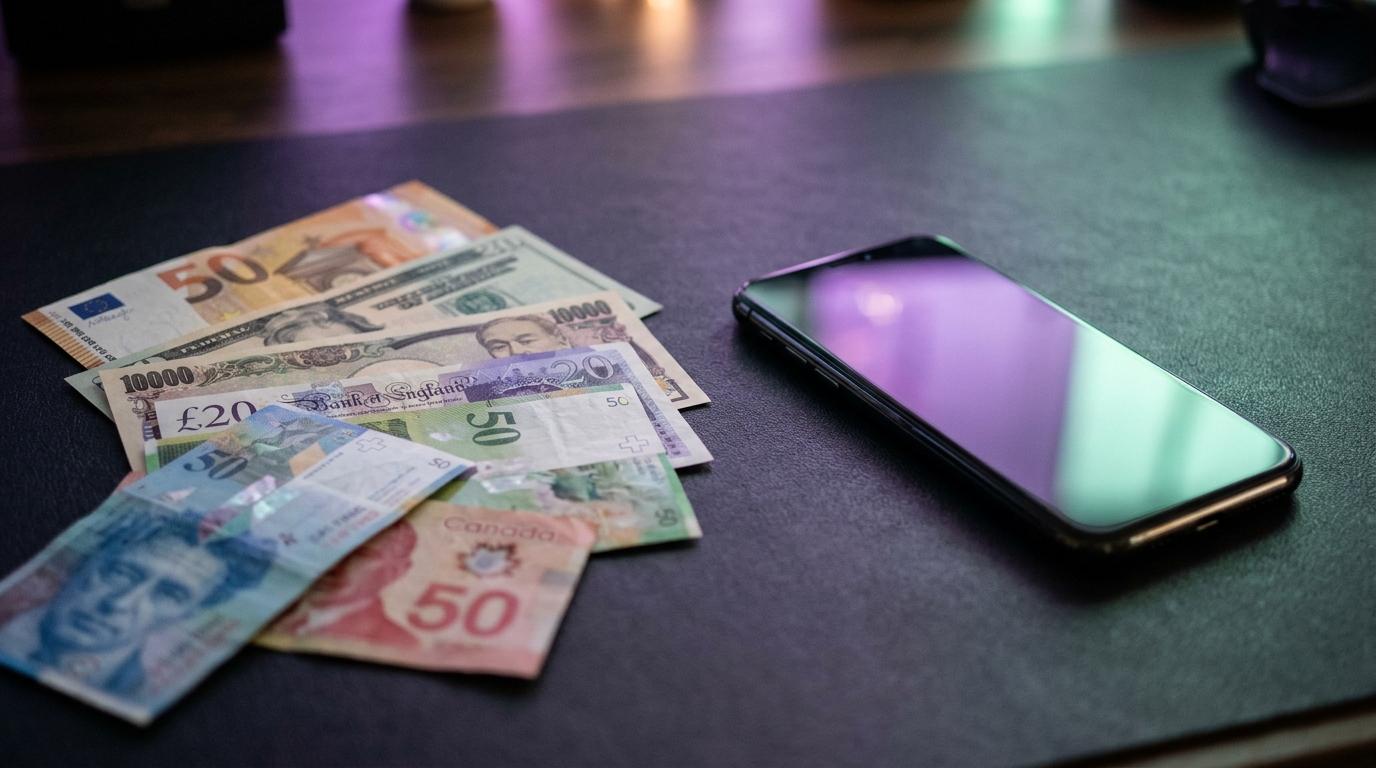
A multi-currency account lets you keep money in a currency other than the euro, under a single contract. For a Belgian resident, it brings almost nothing on a trip. It changes the bill when money arrives, sits or leaves in dollars, pounds or Swiss francs. And both KBC and Belfius now offer one, free of charge.
What exactly is a multi-currency account?
It is an account that holds several separate balances, one per currency, instead of bringing everything back to euros. You receive £500, they stay pounds. You pay in London, the card draws on the pounds with no conversion. You only convert when you decide to.
Belgian banks tend to say "foreign currency account" or "compartment", neobanks say "pockets" or "foreign currency accounts". The mechanism is the same. Only one nuance really matters: some institutions give each currency real local account numbers (a US account number for dollars, a UK sort code for pounds), others only show a balance in the app, funded by conversion or by international transfer.
The difference looks technical.
It decides almost everything else, as we will see below.
The thesis: on a trip, a multi-currency account is almost useless
A card without an FX fee already does the job. When you pay $40 in New York with a Revolut, N26 or Wise card, the amount is converted at the Visa or Mastercard network rate, with little or no markup on weekdays, within a monthly allowance depending on the plan; the mechanism is explained in our article on Visa and Mastercard exchange rates. Holding dollars in advance does not lower that rate, and you have to convert your euros at some point anyway.
For years in a bank branch, I watched customers open a currency account "for the holidays" and forget it on their return, with $37 stuck in it until it was closed. The reflex made sense back when the Belgian debit card charged a fee on every payment outside the euro area, but a card that is free abroad solves that problem without holding anything.
One exception stands up, and it can be quantified. The free plans of neobanks add a markup to weekend conversions, about 1% at Revolut as checked on 30 August and again this autumn. Buying £500 on a Sunday therefore costs nearly €5 more than on the Friday. Converting on Friday into a pound pocket, then paying on Saturday from that balance, wipes out the markup. It helps on a long stay or a big planned purchase.
For three days in Edinburgh, it is overkill.
Three situations where it really changes the bill
A multi-currency account pays off as soon as money does more than a one-way trip from euros into the currency. Three profiles keep coming up in the messages I receive:
- the freelancer or employee paid in dollars or pounds, who does not want to take their bank's rate on every payment received, nor pay international transfer fees on every invoice;
- someone paying a recurring expense in a currency: a student's rent in Geneva, a subscription billed in dollars, an allowance paid to a parent in the United Kingdom;
- someone deliberately keeping money in a currency for a dated project, buying property abroad or a move planned for the summer, who chooses when to convert rather than taking whatever rate comes.
In all three cases, the gain comes from converting only once, at a time you choose, instead of converting on every movement. A freelancer who receives €2,500 worth of dollars a month and converts them back to euros pays their bank's markup twelve times a year; with a dollar balance, they can pay dollar expenses directly and convert only the rest.

Have KBC and Belfius caught up with the neobanks?
On holding currencies, largely. KBC's page, checked on 14 November, describes a foreign currency account presented as a free extra feature of the current account, with 29 currencies listed, from the US dollar to the Moroccan dirham. Conversion in the app is free up to €1,500 a month, then a 1% fee applies to the excess for that month. The recent debit card pays directly in the currency if the balance is sufficient, and cash withdrawals abroad from that balance are advertised with no bank fee, ATM operator fees aside.
KBC even gives its own example: €1,000 spent in Czech koruna costs about €10.41 in FX fees from a euro account, against nothing from the currency account, according to the bank's figures.
Belfius offers a "multi-currency service" on the same principle: currency compartments added to the account, 22 currencies listed, free for private use, €3.75 per half-year for business use. The page, checked the same day, publishes no FX markup figure (conversion happens "at the prevailing rate") and does not mention a card, which limits its appeal for travellers.
The Belgian detail that makes the difference lies elsewhere: the KBC card that pays in dollars in New York is still the Bancontact card that pays the baker in Namur. Bancontact is the Belgian domestic debit card scheme, and no neobank ticks both boxes, as our article on Bancontact and neobanks explains.
The 14 November check, offer by offer
| Offer | Currencies held | Local details outside euro | Fee-free conversion | Above that | Protection |
|---|---|---|---|---|---|
| KBC, foreign currency account | 29 | No (international transfer) | Up to €1,500 a month | 1% of the excess | Belgian guarantee, €100,000 |
| Belfius, multi-currency service | 22 | No | Prevailing rate, markup not published | Not published | Belgian guarantee, €100,000 |
| Wise | About forty (40 advertised) | Yes, 22 currencies including USD and GBP | No: fees from 0.23%, by currency | By currency | Safeguarded funds, no deposit guarantee |
| Revolut Standard | 30+ | Not for EEA customers (SWIFT only) | €1,000 a month on weekdays | Fee on the excess, about 1% at weekends | Lithuanian guarantee, €100,000 |
| bunq | 20 foreign currencies | Not advertised | Not published on its page | Not published | Dutch guarantee, €100,000 |
| N26 | None (euro only) | No | Payments converted at the Mastercard rate | Depends on plan | German guarantee, €100,000 |
Checked on 14 November on the KBC, Belfius and Wise pages (wise.com/be and Wise's European fee schedule). Revolut: Belgian fee page unreachable that day, figures cross-checked with Expatica (updated 4 November) and Primebanque (checked 8 October), which disagree on the fee above the allowance, 0.5% for one, 1% for the other. bunq: bunq article of 6 November 2025. N26: European comparison checked on 26 October. Check the schedule in the app before any large conversion.
The table confirms the thesis on one point and contradicts it on another. To hold currencies and pay with them, a Belgian bank is now enough. To receive currencies, the "local details" column has only one yes.
The serious objection: getting paid in dollars like an American
A US client who pays you by domestic transfer (ACH or a wire within the United States) pays almost nothing. The same client sending a SWIFT transfer to a Belgian IBAN sets off a chain of fees: their bank, sometimes an intermediary bank, then yours. Our article on the BIC code covers the SHA, OUR and BEN fee-sharing options.
This is where Wise keeps its lead. Its Belgian page lists 22 currencies with account numbers, and its European fee schedule, checked on 14 November, shows free receipt of dollars by domestic transfer, against $6.11 per incoming SWIFT transfer. Over twelve invoices a year, the gap is $73.32, not counting the fees taken upstream by the client's banks. For an EEA customer, Revolut only provides, according to Expatica, a euro IBAN and SWIFT details for other currencies; its own help page reserves local dollar and pound account numbers for UK customers.
I had the case with a translator from Liège, paid by an agency in Boston. Her SWIFT transfers arrived $20 to $30 short depending on the month, without her knowing who was taking what. The day the agency could pay her on US account details, the fee line disappeared. She kept her Belgian bank for everything else.
Are your dollars protected if the institution fails?
Yes at a bank, no at Wise, and in both cases the dollar remains a separate risk.
The Deposit Guarantee Schemes Directive 2014/49/EU covers deposits whatever their currency, up to €100,000 per depositor and per institution. Its Article 6(4) states that if the account is held in a currency other than the repayment currency, the exchange rate used is that of the day the authority determines the failure. In Belgium, the Guarantee Fund for Financial Services pays out for KBC and Belfius, in euros. For Revolut, bunq or N26, it is the fund of the licensing country, and our article on neobank deposit protection goes through it brand by brand.
Take $20,000 held in a dollar pocket. If the bank fails, you get their euro equivalent at the rate on the day of the determination; if the dollar has lost 8% since you bought it, that 8% is gone, guarantee or not, because the guarantee protects against failure and never against exchange rates.
Wise, for its part, is an institution authorised by the National Bank of Belgium, but not a bank: its customers' funds are safeguarded in separate accounts, with no deposit guarantee. The difference is explained in our article on e-money institutions versus banks. For a transit balance, it changes little. For dollar savings that sit for months, I prefer a bank.

Do you have to declare a foreign currency account to the Belgian tax authorities?
Only if the institution holding it is established abroad. A pocket at KBC or Belfius is a Belgian account; a pocket at bunq, a Dutch bank, is reported to the Central Point of Contact (CPC) of the National Bank of Belgium along with the bunq account. The details, Revolut and Wise included, are in our article on declaring a foreign account.
A currency pocket, yes; a second account, rarely
My conclusion is more nuanced than the opening thesis. For a traveller, a multi-currency account remains a gimmick, except to avoid the weekend markup on a big purchase. For anyone who regularly holds or spends foreign currencies, the simplest solution is often already in their Belgian bank's app, with the Bancontact card thrown in and the Belgian guarantee. And for anyone paid from abroad, Wise is still the only one offering real US dollar account numbers to a Belgian resident, at the cost of weaker protection on balances that sit.
I keep the two uses apart: dollars in transit go through Wise, savings stay in euros at a bank. To put neobanks side by side on FX fees, the comparator does the sorting, and our head-to-head Wise or Revolut settles it between the two apps most used for currencies.
This article is general information about fees and conditions; it is neither investment advice nor tax advice.
Sources: KBC, "Compte en devises" page for private customers, checked on 14 November; Belfius, "Service multi-devise" page, checked on 14 November; Wise, Belgian page (wise.com/be) and European fee schedule, checked on 14 November; bunq, "Qu'est-ce qu'un compte multidevises", 6 November 2025; Expatica, "Best multi-currency accounts in Belgium", updated 4 November; Primebanque, Revolut fees checked on 8 October; Revolut help page on available account details; Directive 2014/49/EU, Article 6(4); Guarantee Fund for Financial Services (FPS Finance).
Frais à l’étranger comparator
Compare all frais à l’étranger side by side.
Compare now →
Frequently asked questions
Maxime suit le secteur des néobanques et de la fintech belge depuis près de dix ans. Ancien conseiller en agence devenu analyste indépendant, il ouvre et teste lui-même les comptes qu’il compare, décortique les grilles tarifaires ligne par ligne et traque les frais cachés derrière les offres « gratuites ». Son objectif : aider les Belges à payer moins et choisir une banque qui colle vraiment à leur usage, sans jargon ni argument commercial.