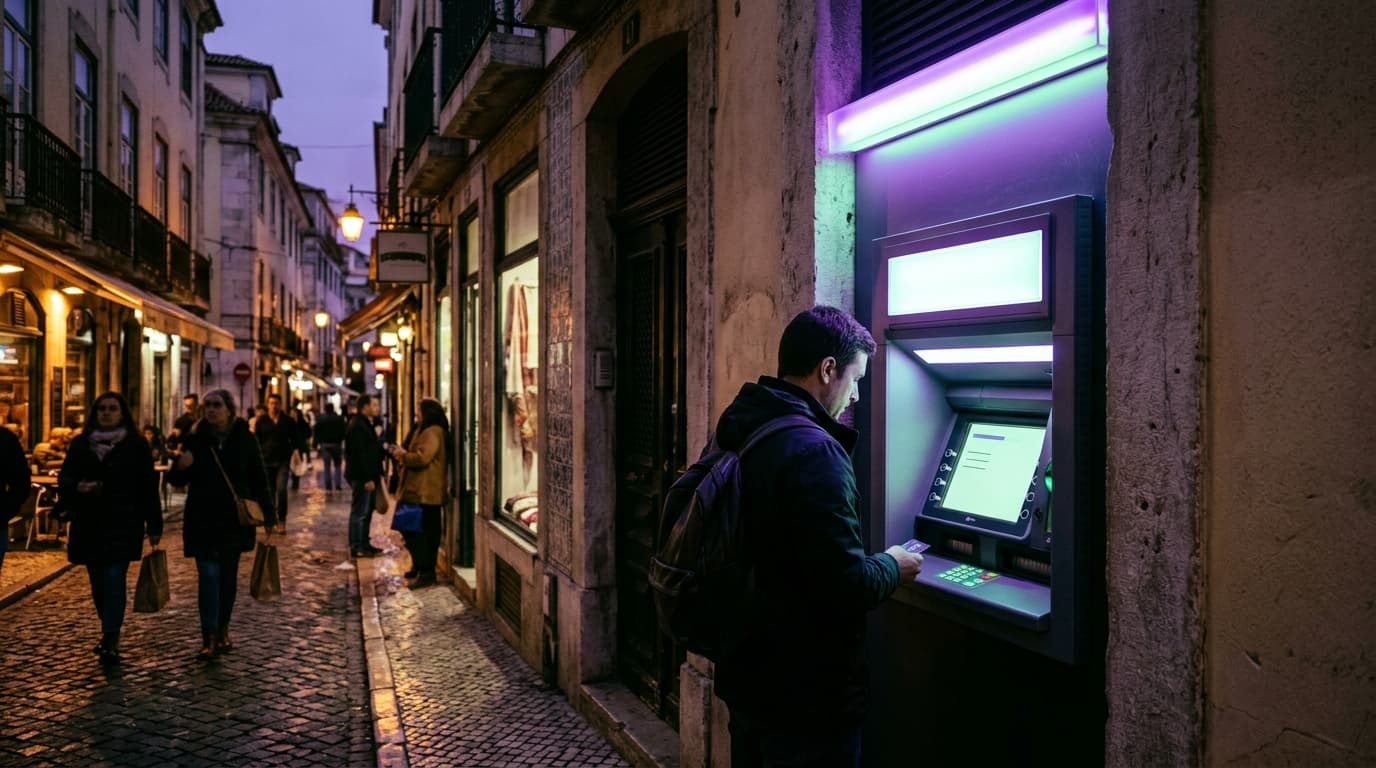
A withdrawal abroad with a neobank is free up to a monthly allowance, then charged as a percentage. The trap rarely sits in the neobank's own price list. It hides in the cash machine operator's fee, in the "euros" button on the screen, and in an allowance calculated over a rolling month.
How much does a withdrawal abroad cost with a neobank?
Three layers add up, and only the first depends on your neobank.
- The neobank's fees: free up to a monthly allowance, then a percentage of the amount withdrawn.
- The cash machine operator's fees, set by the local bank or the machine's owner, shown on screen before you confirm.
- The conversion, at your neobank's rate if you choose the local currency, at the machine's rate if you accept euros.
The first layer can be compared on paper. The other two are settled in front of the screen, in ten seconds, and they are what turns a €100 withdrawal into a €110 one.
Revolut, N26, Wise: how many free withdrawals per month?
I checked the public price lists on 26 October 2026. Each one counts differently, which is exactly what makes the comparison misleading: Revolut counts in amount and in number, N26 in number only for euros, Wise in amount.
| Plan | Free each month | Beyond that | Withdrawal outside the eurozone |
|---|---|---|---|
| Revolut Standard (free) | 5 withdrawals or €200, rolling month | 2%, minimum €1 per withdrawal | Same allowance, then 2% |
| Revolut Premium (€9.99/month) | €400, rolling month | 2%, minimum €1 | Same allowance, then 2% |
| Revolut Metal (€17.99/month) | €800, rolling month | 2%, minimum €1 | Same allowance, then 2% |
| N26 Standard (free) | 2 euro withdrawals | €2 per withdrawal | 1.7% on each withdrawal, outside the allowance |
| N26 Smart | 3 euro withdrawals | €2 per withdrawal | 1.7% on each withdrawal, outside the allowance |
| Wise (euro account) | €250 | 2.69% on the part over the limit | Same rule, conversion charged separately |
| Belfius, debit card | 24 withdrawals a year in the SEPA area (depending on the account) | €0.50 per withdrawal | €5 + 1%, plus a 1.50% exchange margin |
Sources: Revolut Standard price list (version applicable from 15 October 2026), Premium and Metal price lists (version from 9 July 2026), N26 help page on free withdrawals, Wise card price list for a euro account, Belfius rates in force on 1 February 2026. All checked on 26 October 2026.
One line deserves a closer look. Revolut's rolling month does not reset on the 1st: it runs for thirty days from your withdrawals. I learned it in Edinburgh, withdrawing on the 3rd of the month and counting on a fresh allowance. It was not fresh, and the 2% landed on a withdrawal I thought was free. Since then, I note the date of my first travel withdrawal in my phone's calendar.
€600 withdrawn in the United States: the bill, card by card
Take a two-week trip, three withdrawals of €200 in dollars, on weekdays, in the same month, with no other withdrawal over the period.
| Card | Calculation | Card fees |
|---|---|---|
| Revolut Standard | 1st withdrawal free, then 2 × (2% of €200) | €8.00 |
| Revolut Premium | €400 free, then 2% of €200 | €4.00 |
| Wise | 2.69% of €350, before conversion fees | €9.42 |
| N26 Standard | 1.7% of €600 | €10.20 |
| Belfius, debit card | 3 × (€5 + 1% of €200) + 1.50% of €600 | €30.00 |
Calculation made on 26 October 2026 from the price lists quoted above. A single €200 withdrawal on a Saturday with Revolut Standard adds a 1% weekend markup on the conversion, so €2 more.
The gap between neobanks comes down to a few euros. The gap with the Belgian card is close to fourfold. And in every case you still have to add the cash machine operator's fee, which nobody can quote in advance: in Chicago, a convenience-store machine showed me a $4.50 surcharge on a $200 withdrawal, more than half of what Revolut would have charged me for the whole week.
How do you withdraw cash abroad without fees?
You will not always get to zero, but you get close with a method held from departure to return:
- Check your allowance before leaving. The fees screen in the app shows what is left for the current month. At Revolut, look at the date of your oldest withdrawal in the last thirty days.
- Withdraw less often, and more each time. A minimum per withdrawal (€1 at Revolut) or a fixed fee (€5 at Belfius) penalises small amounts. Three withdrawals of €200 cost less than ten of €60.
- Choose a local bank's machine, in a branch or a bank lobby, rather than an independent terminal at an airport, a station or on a shopping street.
- Read the fees screen before confirming. An announced surcharge can be refused: cancel, the card comes back out, and the next machine may charge nothing.
- Decline the conversion into euros when the screen offers it, and choose the local currency.
- Withdraw on weekdays if your plan adds a markup to conversions from Friday evening to Sunday evening.
- Pay by card whenever possible, since foreign-currency payments do not draw on the withdrawal allowance.
Why does the cash machine charge extra fees?
Because the machine belongs to someone who is not your bank, and who earns money on every foreign card swiped. Revolut says so plainly in its help pages: those fees must be shown before you confirm, and they come on top of its own.
The second charge is sneakier. The screen offers to "lock in" the amount in euros, and that offer, dynamic currency conversion, applies a rate chosen by the machine's operator, with a margin no cap restricts. Regulation (EU) 2019/518 requires that margin to be shown as a percentage above the European Central Bank's reference rate. Read it, then decline anyway. The mechanism is detailed in our glossary of Visa and Mastercard exchange rates.

In the eurozone or in Belgium, do the rules change?
Yes, and mostly in your favour. Regulation (EU) 2021/1230 requires a euro withdrawal in another EU country to cost the same as a domestic one. Your Belgian card therefore withdraws in Lisbon at the Liège price.
On the neobank side, the eurozone and Belgium draw on the same allowance as the rest of the world at Revolut and Wise. At N26, euro withdrawals, in Belgium as in Madrid, share the monthly allowance of two or three free withdrawals, then cost €2 each. None of these cards needs Bancontact, the Belgian domestic debit card scheme, to withdraw cash: Belgian machines accept Visa and Mastercard. It is in shops that the Belgian scheme lets them down, as our article on neobanks and Bancontact shows, and paying cash into the account is covered separately in our guide to cash deposits.
Six mistakes that make you pay twice for a withdrawal
- Counting on an allowance that resets on the 1st of the month.
- Accepting "EUR" on the screen.
- Making repeated €40 or €50 withdrawals.
- Withdrawing on a Saturday on a free plan.
- Heading straight for the airport terminal.
- Travelling with a single card.
Is withdrawing with a neobank still better than with a Belgian card?
Outside the eurozone, clearly. Inside the eurozone, the advantage shrinks, since EU law already protects the Belgian card there, and a bank that includes your withdrawals in its monthly package can even beat N26 Standard beyond two withdrawals a month.
The right set-up remains the one I recommend to almost every traveller: the neobank for paying and withdrawing abroad, the Belgian card as a backup in another compartment of the wallet. To pick the plan whose allowance fits the way you travel, our comparator puts the price lists side by side, and the guide to the best neobank for travel covers the rest of the fees abroad. Wikifin, the financial education website of the FSMA, Belgium's financial markets regulator, also reminds you to reread your price list before every trip.
This article provides pricing information and is neither legal advice nor investment advice.
Sources: Revolut Standard, Premium and Metal price lists (Belgian branch), N26 help page on free withdrawals, Wise card price list for a euro account, Revolut help page on fees charged by the cash machine operator, Belfius rates in force on 1 February 2026, Regulation (EU) 2021/1230 on cross-border payments, Regulation (EU) 2019/518 on currency conversion charges, Wikifin (FSMA), checked on 26 October 2026.
Frais à l’étranger comparator
Compare all frais à l’étranger side by side.
Compare now →
Frequently asked questions
Maxime suit le secteur des néobanques et de la fintech belge depuis près de dix ans. Ancien conseiller en agence devenu analyste indépendant, il ouvre et teste lui-même les comptes qu’il compare, décortique les grilles tarifaires ligne par ligne et traque les frais cachés derrière les offres « gratuites ». Son objectif : aider les Belges à payer moins et choisir une banque qui colle vraiment à leur usage, sans jargon ni argument commercial.