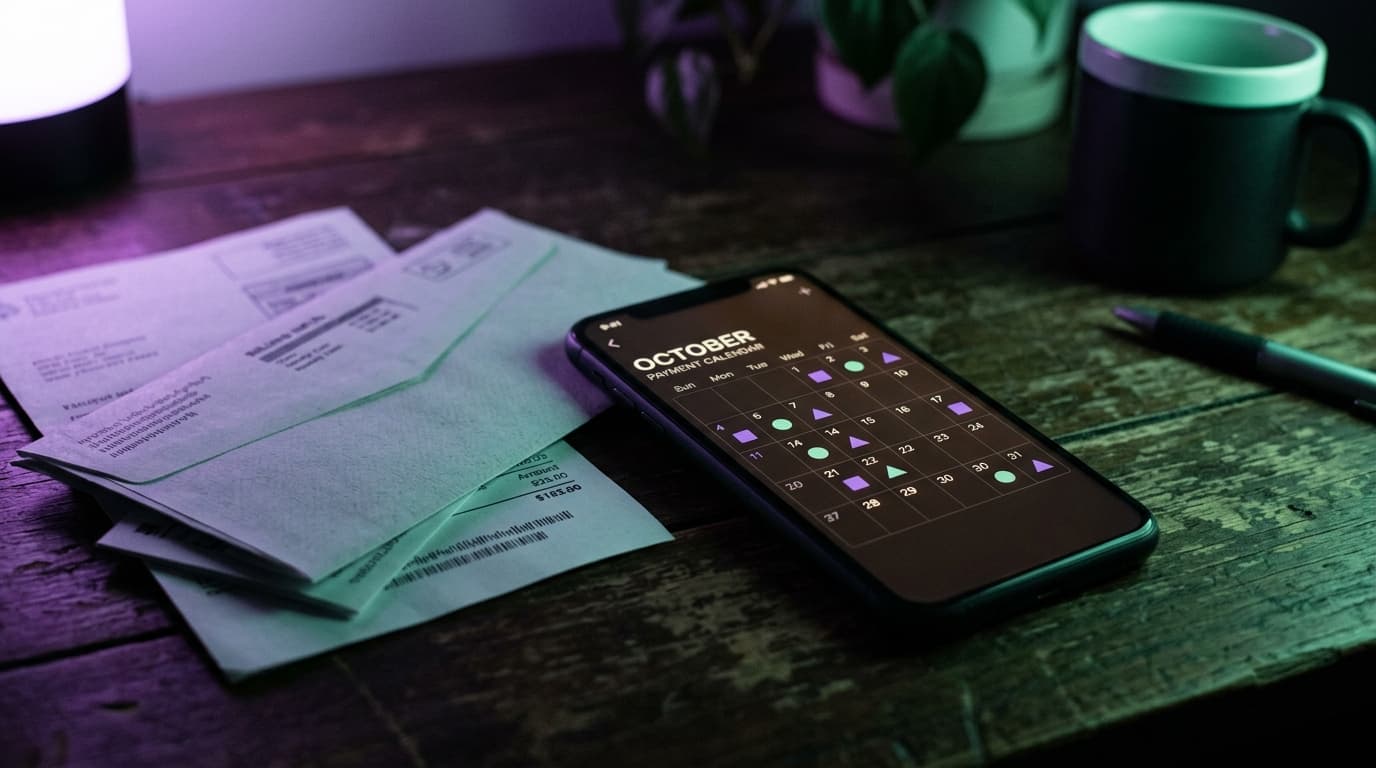
A standing order means you pay: a fixed amount on a fixed date, set up once with your bank. A direct debit, which Belgians call a domiciliation, means the creditor collects, under a mandate you signed, and the amount can change from one month to the next. That difference also decides what you can do when something goes wrong.
What is the difference between a standing order and a direct debit?
It all comes down to one question: who presses the button? With a standing order, you do, every month, through your bank. With a direct debit, your supplier does, and your bank simply carries it out as long as the mandate is valid.
Belgian banking vocabulary groups six related operations under these two logics. Here they are side by side.
| Operation | Who triggers it | Amount | Recoverable afterwards? | Common example |
|---|---|---|---|---|
| Transfer | You, once | Whatever you type | No, unless the payee agrees | Paying a garage invoice |
| Transfer with a memo date | You, in advance | Fixed | No, but can be cancelled before the due date | Paying an invoice at 30 days |
| Standing order | You, repeated automatically | Fixed, changeable by you only | No | Rent of €950 on the 1st |
| SEPA Core direct debit | The creditor, under a mandate | Variable, set by the creditor | Yes, 8 weeks unconditionally | Electricity instalment, health insurance fund |
| SEPA B2B direct debit | The creditor, under a business mandate | Variable | No | A company's supplier |
| Recurring card payment | The merchant, on your card | Variable | Through a dispute with the card issuer | Streaming subscription |
Rules checked on 20 October 2026 on Wikifin (FSMA), Febelfin and Regulation (EU) 260/2012.
What is a domiciliation in Belgium?
It is the Belgian name for the European automatic collection, known in the legal texts as a SEPA Direct Debit. The word trips up anyone looking for a definition on a French page. In France, the « domiciliation bancaire » is the branch that holds the account, the one printed under the bank's name on a RIB, and a direct debit is called a prélèvement. Same word, two unrelated things.
A Belgian direct debit rests on a mandate. You sign it with the creditor, not with your bank, and it carries three items: your IBAN, a mandate reference and the creditor identifier, a string such as BE69 ZZZ 050D000000008 built in Belgium on the company number. Wikifin, the financial education website run by the FSMA, the Belgian financial markets regulator, points out that consent given over the phone is not a mandate. The creditor should in principle notify you at least 14 calendar days before each collection, and a mandate left unused for 36 months expires on its own, according to Febelfin's SEPA brochure.
Standing order: who sets the amount and how do you stop it?
You do, and only you. A standing order is created, changed and deleted in your banking app, without the payee knowing anything about it.
The flip side is blunt: money sent is gone.
I learned this when I left a flat in Etterbeek. I had ended the lease, handed back the keys, recovered the rental deposit, and forgotten the rent standing order, which went out twice more before I noticed. The landlord refunded me, graciously, but my bank could have done nothing without him.
Can you get a direct debit refunded?
Yes, and it is the big advantage of the direct debit over everything else. For a SEPA Core direct debit, the one used by individuals, you can ask your bank to refund any collection within 8 weeks of the debit, without giving a reason. If the creditor never had a valid mandate, the window extends to 13 months. The EU Payment Services Directive then gives the bank ten business days to refund or explain a refusal.
Take a case I see every winter. Your energy supplier usually collects an instalment of €128. In January, a billing error on the annual adjustment takes €1,280 in one go, on the same day your rent leaves. You request the refund in the app, the money comes back, and you avoid going overdrawn. You still owe the amount actually due once the invoice is corrected, because the refund cancels the payment, never the debt.
The request is usually made from the app or online banking, by opening the transaction concerned. Tell the creditor straight away, in writing: otherwise they will present the collection again the following month, or add reminder fees on the basis that you have not paid. Keep a record of the date of your request, because the 8-week window runs from the day of the debit, not from the invoice date.
One limit to know: the B2B direct debit, reserved for businesses, gives no refund right. A self-employed person who signed one must dispute it directly with the creditor.
How do you block or limit direct debits on your account?
Article 5 of Regulation (EU) 260/2012 requires your bank to offer you these protections, which Febelfin, the Belgian banking federation, sets out on its page on consumer rights regarding direct debits:
- refuse all direct debits on the account;
- cap the amount of a collection, for example €300 for your energy supplier;
- limit the frequency, to once a month at most;
- keep a whitelist, where only chosen creditors can collect;
- keep a blacklist, where certain creditors are excluded;
- block one specific mandate without touching the others.
KBC, for instance, offers these blocks at three levels: the account, the creditor or the mandate, the last one available from online banking. The cap is the most underused tool on the list. Set at twice the usual instalment, it would have stopped the €1,280 collection in the example above.
Do neobanks handle Belgian direct debits?
Yes, all the major neobanks active in Belgium accept SEPA direct debits in euros. The differences lie in the IBAN and in how you get a refund.
| Neobank | IBAN provided | 8-week refund | Unauthorised mandate |
|---|---|---|---|
| Revolut | BE or LT depending on when the account was opened | Unconditional, on request to support, according to its terms | Dispute through the in-app chat |
| N26 | DE | From the transaction, in the app, funds available immediately | 13 months |
| Wise | BE for euro accounts | « Request a refund » button, visible one business day after the debit | Beyond 8 weeks, only if unauthorised |
Help pages and terms of Revolut, N26 and Wise checked on 20 October 2026. Wise excludes the SEPA B2B scheme from its euro accounts.
The real obstacle is the foreign IBAN, from a bank such as N26 or bunq. Some Belgian creditors still refuse an account that does not start with BE, even though Article 9 of the same regulation explicitly prohibits imposing the country of the account. In 2023, my health insurance fund sent back my direct debit form for a German IBAN twice before accepting it, after a simple written reminder of that article. Refusals can be reported to the FPS Economy, the Belgian federal economy ministry, and our article on foreign IBANs in Belgium explains what to do. For N26 as for Wise, the refund procedure is described step by step on their help pages.

Direct debit, standing order or card: which one for each expense?
The right tool depends on a single thing: does the amount change?
| Expense | Suitable tool | Recommended setting |
|---|---|---|
| Fixed rent | Standing order | Delete it the day you hand back the keys |
| Electricity and gas | Direct debit | Cap at twice the instalment |
| Phone and internet | Direct debit | Check the pre-notification every month |
| Monthly savings | Standing order | To your savings account, the day after payday |
| Online subscription | Virtual card | One card per subscription, can be frozen at any time |
| Unknown collection | Refund | Request within 13 months, then block the creditor |
For online subscriptions, the virtual card keeps the edge, because a recurring card payment is not covered by the 8-week rule: it is disputed with the card issuer, following a procedure we describe in our article on bank fraud refunds. If you are planning to switch accounts, the article on moving to a neobank explains why each direct debit then has to be set up again, mandate by mandate.
In short
A standing order leaves you in control of the amount and cannot be undone. A direct debit leaves that control to the creditor, but protects you in return: an unconditional refund for 8 weeks, 13 months without a valid mandate, and a cap or whitelist you can set at any time. Neobanks follow the same rules as Belgian banks, and the comparison tool lines them up side by side, IBAN included.
This article provides general information on payment methods in Belgium and is neither legal advice nor investment advice.
Sources: Regulation (EU) No 260/2012 establishing technical and business requirements for credit transfers and direct debits in euro, Articles 5 and 9; Directive (EU) 2015/2366 on payment services, Articles 76 and 77; Wikifin (FSMA), « Paiements », updated 14 July 2026; Febelfin, « What are your rights as a consumer regarding direct debits? » and SEPA Direct Debit brochure; KBC, « Comment fonctionne la domiciliation ? »; Belfius, « Payer avec une domiciliation »; help pages and terms of Revolut, N26 and Wise checked on 20 October 2026.
Cartes & paiements comparator
Compare all cartes & paiements side by side.
Compare now →
Frequently asked questions
Maxime suit le secteur des néobanques et de la fintech belge depuis près de dix ans. Ancien conseiller en agence devenu analyste indépendant, il ouvre et teste lui-même les comptes qu’il compare, décortique les grilles tarifaires ligne par ligne et traque les frais cachés derrière les offres « gratuites ». Son objectif : aider les Belges à payer moins et choisir une banque qui colle vraiment à leur usage, sans jargon ni argument commercial.