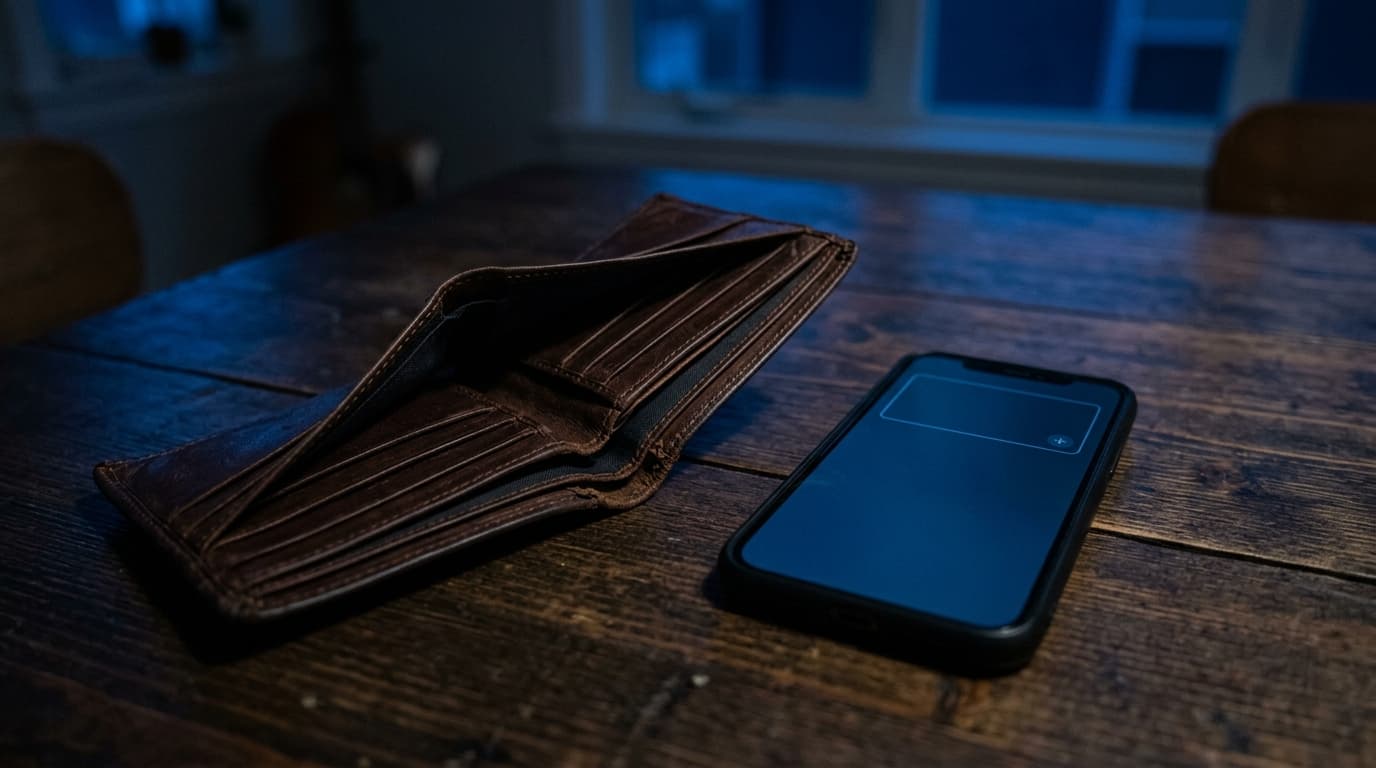
Freeze the card in the app before anything else: with Revolut, N26, bunq or Wise, that is the only channel that works. Card Stop, the Belgian reflex, does not cover these cards. The police report, the payment dispute and the replacement card come afterwards. Here is the exact order, with the deadlines and what Belgian law guarantees you.
What should you do in the first ten minutes?
Three moves, in this order: freeze the card in the app, check the latest transactions, then report the card as lost or stolen to cancel it. Count on less than two minutes, at no cost.
Freezing and reporting do not do the same thing, and this is where many people get it wrong. Freezing is reversible: the card is suspended and you switch it back on in one tap if it turns up. Reporting is final: the card is cancelled and a new one is ordered. At Revolut, N26, bunq and Wise, the freeze button sits on the card screen, right from the home view.
The sequence to follow:
- Open the app, select the card, tap "Freeze" (10 to 20 seconds).
- Scroll through the last 48 hours of transactions and note any unknown debit.
- If the theft is certain, choose "Card lost or stolen" to cancel it and order the next one.
- Create a virtual card to keep paying while the physical one is on its way.
- Check the virtual cards you already created: they stay active unless you delete them.
One Sunday in March, at Brussels-South station, I realised on the platform that my wallet had gone. Card frozen in twenty seconds, before I had even searched my bag. The wallet had fallen out on the train and came back to me two hours later: I unfroze the card, and there was nothing else to do. Had I cancelled straight away, I would have waited ten days for a new card for nothing.
Does Card Stop block a Revolut, N26 or bunq card?
No, and almost nobody in Belgium knows it. Card Stop, reachable on 078 170 170 around the clock, blocks payment instruments issued by affiliated Belgian institutions — debit and credit cards, meal vouchers, fuel cards. Cards from Revolut (licensed in Lithuania), N26 (Germany) and bunq (the Netherlands) are not connected to that system.
Calling Card Stop for a neobank card therefore blocks nothing, and burns the only moment when speed really matters. Wise is a slightly different case, since the group's European entity is an electronic money institution licensed in Belgium: blocking still goes through the app, not through Card Stop.
A friend had his wallet stolen at the Anderlecht market last spring. He called Card Stop, waited, explained twice, and was told his N26 card was not in the system. Forty minutes lost, during which three contactless payments went through. Keep the Card Stop number for your Belgian card — it changed, it is indeed 078 170 170 since 2024 — and keep the neobank app for the rest.
How do you block your card in the app, step by step?
The journey is almost identical at all four: card screen, instant freeze, then the "card lost or stolen" menu. What differs is the human support behind it, and how fast you get a means of payment back.
Current picture as of summer 2026. Apps change quickly: check the exact wording of the menus when you actually need them.
| Neobank | Reversible freeze | Lost or stolen report | Instant virtual card | Human support |
|---|---|---|---|---|
| Revolut | Yes, one tap | Yes, immediate cancellation | Yes | In-app chat, 24/7 |
| N26 | Yes | Yes | Yes, depending on the plan | Chat and phone, published hours |
| bunq | Yes | Yes | Yes | In-app chat |
| Wise | Yes | Yes | Yes, digital card | Chat and phone, published hours |
Concretely, for everyday use: the virtual card is the real safety net. It is created in seconds, added to Apple Pay or Google Pay, and gives you back in-store and online payments while the physical card is in transit. It is also what sets a neobank apart from a traditional bank in this precise situation — more on that in our guide to virtual cards from neobanks.
Should you file a police report in Belgium?
Yes, as soon as there is theft or a fraudulent payment. The report is not a legal condition for a refund, but the Belgian police recommend it and most providers ask for it once the amounts pass a few dozen euros.
It is free and done at your local police station, without an appointment in most police zones. Allow about thirty minutes, bring your ID card, and above all the list of disputed transactions with dates, amounts and merchants, exported from the app. You leave with a case number to attach to your complaint.
Two details that save time: report the theft and the fraudulent use in one go; and if the theft happened abroad, the report can be filed in Belgium once you are back, even though the case will move more slowly.
How do you get fraudulent payments refunded?
By disputing the transactions in the app, then leaning on Book VII of the Belgian Code of Economic Law, which implements the European payment services directive. The provider must refund unauthorised transactions by the end of the business day following your notification, unless there is a reasoned suspicion of fraud.
The figures, as set out by Wikifin, the FSMA's financial education site:
- Before your notification, the share left to you is capped at €50.
- That share drops to zero if the card was counterfeited, or used remotely without electronic identification — an online purchase not validated in the app, typically.
- After notification, nothing is charged to you.
- The dispute window is 13 months from the debit.
- The burden of proof lies with the provider: it is up to them to demonstrate gross negligence, not up to you to prove you were careful.
Gross negligence, on the other hand, costs everything: a PIN written on the card, a code given to someone over the phone, approval of a payment notification you did not trigger. Phishing by fake bank text message is still the leading reason for refusal in Belgium, and providers fight those cases file by file.
My two cases took very different paths. A dispute filed on a Tuesday evening in the app was refunded on the Friday. Another was refused first, with an automated reply about "validation by the cardholder"; it took a written follow-up quoting the legal deadline and the police report to get the refund, three weeks later. Write things down, keep everything, and do not settle for a chat thread.
How much does a replacement card cost, and how long does it take?
The virtual card is instant and free at all four neobanks. The physical replacement is charged on most free plans — from a few euros to around ten depending on the issuer and the card type — and arrives within 5 to 10 business days in Belgium. Express delivery exists, for an extra fee.
Watch the small print: replacement is often included on paid plans, which changes the maths if you are still hesitating between two of them. Pricing grids move regularly, so check the one in force when you order.
The hidden cost is time. A new number and a new security code mean every card-based payment has to be updated: streaming subscriptions, telecom operator, apps, saved car parks. I counted twenty minutes last time, and still forgot two, discovered through a declined payment three weeks later. SEPA direct debits on the account are not affected — the card changes, not the IBAN.

What if the neobank refuses to refund?
Three steps, in order, none of which costs money. First a written complaint to the provider's complaints department, which must answer within a set deadline. Then Ombudsfin, the Belgian mediator for financial disputes, free for consumers. Finally the FPS Economy, whose Economic Inspectorate can be contacted about a payment service.
The neobank-specific point deserves to be stated plainly: when the institution is licensed abroad and operates here under freedom to provide services, Ombudsfin can pass the case to the competent body in the home country through FIN-NET, the European network of financial mediators. It works, but it stretches the timeline, and the procedure sometimes runs in another language. That is the price of a foreign licence, just like deposit protection sitting in a foreign fund, a topic we cover in our article on neobank deposit protection.
One practical piece of advice from two cases: build the file from day one. Screenshot of the transaction history, timestamp of the card freeze, police case number, exchanges with support. A documented complaint almost always goes through; a complaint told from memory six weeks later gets lost.
Which mistakes cost the most after a theft?
The ones that waste time at the very start, and the ones that damage the file. The five I keep seeing:
- Calling Card Stop and believing the card is blocked, when nothing is.
- Waiting until the next morning "to call someone": every hour allows more contactless payments.
- Cancelling the card before searching properly — ten days of waiting for a card found the same evening.
- Forgetting the virtual cards linked to the same account, which stay active after the physical card is cancelled.
- Replying to the "your bank" text message received right after the theft: that is the classic follow-up scam, and it is what gets a case reclassified as gross negligence.
✓ Pros
- Card frozen in one tap, 24/7, with no call and no queue
- Virtual card available immediately so you can keep paying
- Dispute filed directly in the app, with a written trail
- Real-time notifications: an unknown debit shows up within seconds
✗ Cons
- Card Stop does not block these cards: the Belgian reflex is useless
- No branch and no adviser to talk to face to face
- Chat-only support at several of them
- Slower appeals when the provider is licensed abroad
In short
A stolen neobank card is blocked in the app, not over the phone: Card Stop does not cover Revolut, N26 or bunq. Freeze first, check the history, then report the theft to cancel the card and create a virtual one straight away. File a police report, dispute the transactions in the app, and quote the Belgian rules if needed: €50 maximum charged to you before notification, nothing after, 13 months to dispute, burden of proof on the provider. If the refund is refused, a written complaint followed by Ombudsfin settles most cases. To pick a neobank with support and guarantees in mind, our comparator puts the offers side by side and the quiz gives a recommendation in two minutes.
Sources: Wikifin (FSMA), "Payment card lost or stolen"; Card Stop and Febelfin (078 170 170 number, scope of covered cards); police.be, loss or theft of a card; Book VII of the Belgian Code of Economic Law (implementation of the European payment services directive); Test-Achats, files on card fraud and refunds (2025-2026); Ombudsfin and the FIN-NET network; National Bank of Belgium and FSMA (status of institutions); documentation and terms from Revolut, N26, bunq and Wise consulted in August 2026.
Cartes & paiements comparator
Compare all cartes & paiements side by side.
Compare now →
Frequently asked questions
Maxime suit le secteur des néobanques et de la fintech belge depuis près de dix ans. Ancien conseiller en agence devenu analyste indépendant, il ouvre et teste lui-même les comptes qu’il compare, décortique les grilles tarifaires ligne par ligne et traque les frais cachés derrière les offres « gratuites ». Son objectif : aider les Belges à payer moins et choisir une banque qui colle vraiment à leur usage, sans jargon ni argument commercial.